
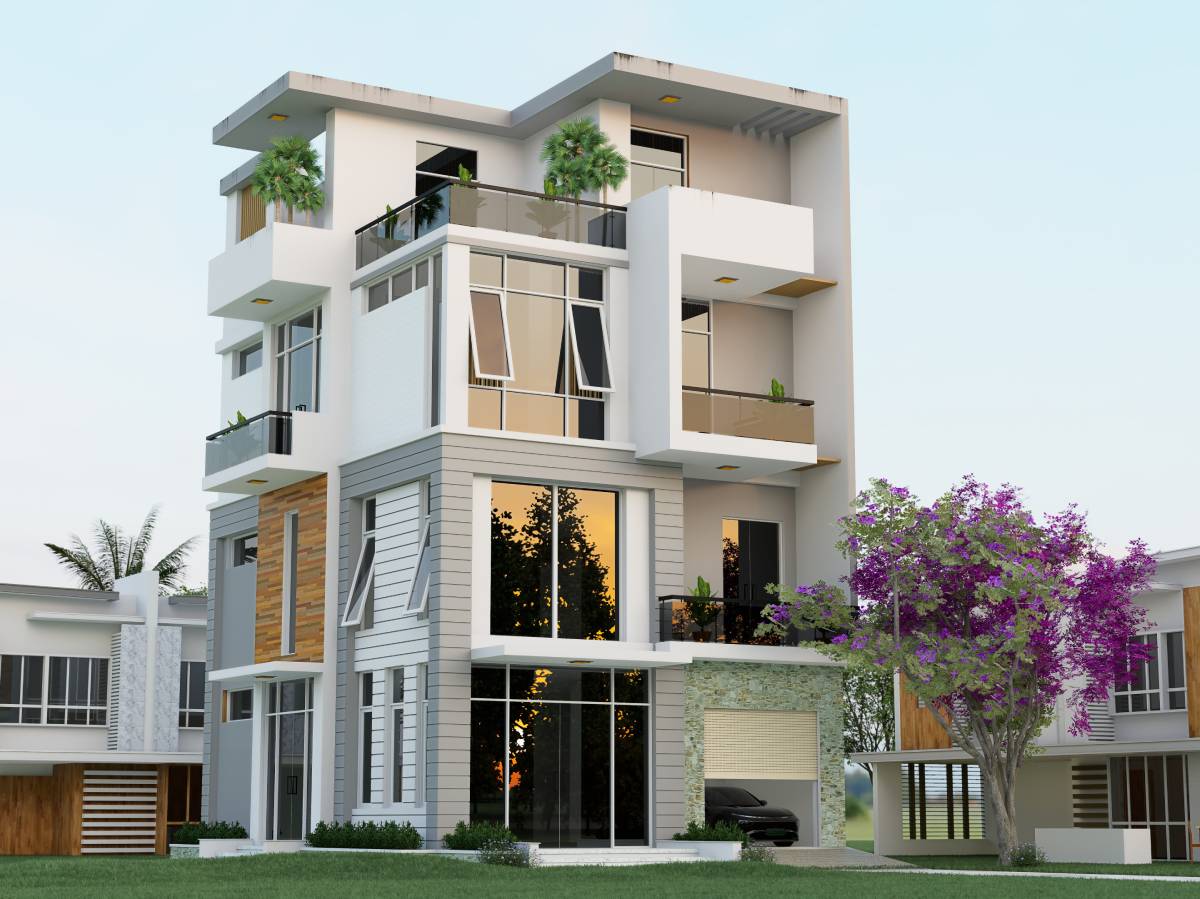
 Illustrative image – not actual.
On 5 December 2001, Pakistan’s Federal Cabinet approved the National Housing Policy 2001, outlining the government's role as a facilitator and regulator to stimulate economic activity and employment generation.
The policy outlines inputs required for revitalizing the housing sector including financial and legal measures, indigenous production and use of building materials and construction techniques. It also specifies policy guidelines for low-cost housing, slums and katcha abadis, rural housing and institutional and legal framework with clearly defined roles of the federal, provincial and local governments in the housing sector.
The features of the policy are as follows:
(i)
Stamp duties/ registration fees are being rationalised by the
governments of Punjab and Sindh.
(ii)
Duties on construction machinery, ship-building scrap and coal-fired
cement plants have been reduced.
(iii)
Mark-up on housing loans have been made tax deductible upto 25 per cent
of income tax.
(iv)
The provincial governments have been asked to identify Shamlat deh
lands, which could be transferred to individuals and families residing on them.
A committee constituted by the Ministry of Housing and Works, which includes
representatives from provincial governments, architects and Ministry of
Environment, Local Government and Rural Development, will shortly submit
recommendations on the issue.
(v)
The State Bank has allowed Housing Finance Institutions (HFIs) to float
long-term bonds for housing finance.
(vi)
The State Bank has issued revised instructions to commercial banks
allowing them to provide mortgage financing for construction of houses to the
extent of Rs.5 million for a maximum period of 15 years. The HBFC has been
authorized to undertake activities for raising funds through commercial papers,
redeemable capital (PTCs & TFCs) etc.
(vii)
The banks have been allowed to have an exposure under housing finance
to the extent of five per cent of their net advances which is a substantial
amount keeping in view net advances of Rs.886 billion of commercial banks as on
31-12-2000.
(viii)
The State Bank has conveyed no objection to the promotion of Housing
Finance Institutions to encourage savings and provide credit from
community-based finance and other sources. Further, the banks/HFCs are being
advised to devise procedure for the same.
(ix)
The State Bank has also conveyed its no objection to increase in the
annual disbursement of HBFC loans from the present Rs.1.2 billion to Rs.7
billion over the next 5 years, provided the HBFC is able to raise resources
enabling it to disburse the amount to the extent of desired level without any
credit line from the State Bank.
(x)
The HBFC has informed that since the State Bank's credit line to HBFC
is stopped since 1994, it will have to raise funds from the market to enhance
its annual disbursement to Rs.7 billion for which the restructuring of the
corporation is a pre-requisite. They have taken up the issue with the finance
ministry.
(xi)
The State Bank has conveyed its no objection to the reintroduction of
bridge financing and bulk financing of housing projects through escrow
accounting together with appropriate safeguards by the HBFC subject to the
condition that the corporation is able to raise resources enabling it to
disburse the amount to the extent of desired level without any credit line from
State Bank.
(xii)
Housing has already been declared a category 'C' priority industry and
is entitled to concessionary rate of 10 per cent import duty on machinery not
manufactured in Pakistan.
(xiii)
The Ministry of Housing and Works in coordination with the provincial
governments should develop a package for improving the living conditions in katcha
abadis and slums.
(xiv)
The dangerously located slums should be shifted to alternate locations
on state land within the cities under a smooth and organized manner. For this
purpose low-cost housing schemes should be developed.
(xv)
The master plans under the housing policy should be prepared for the
metropolitan and major cities by the provincial governments within three years
and development plans for district level cities/towns and union councils should
be prepared by the local governments and union councils within two years.