
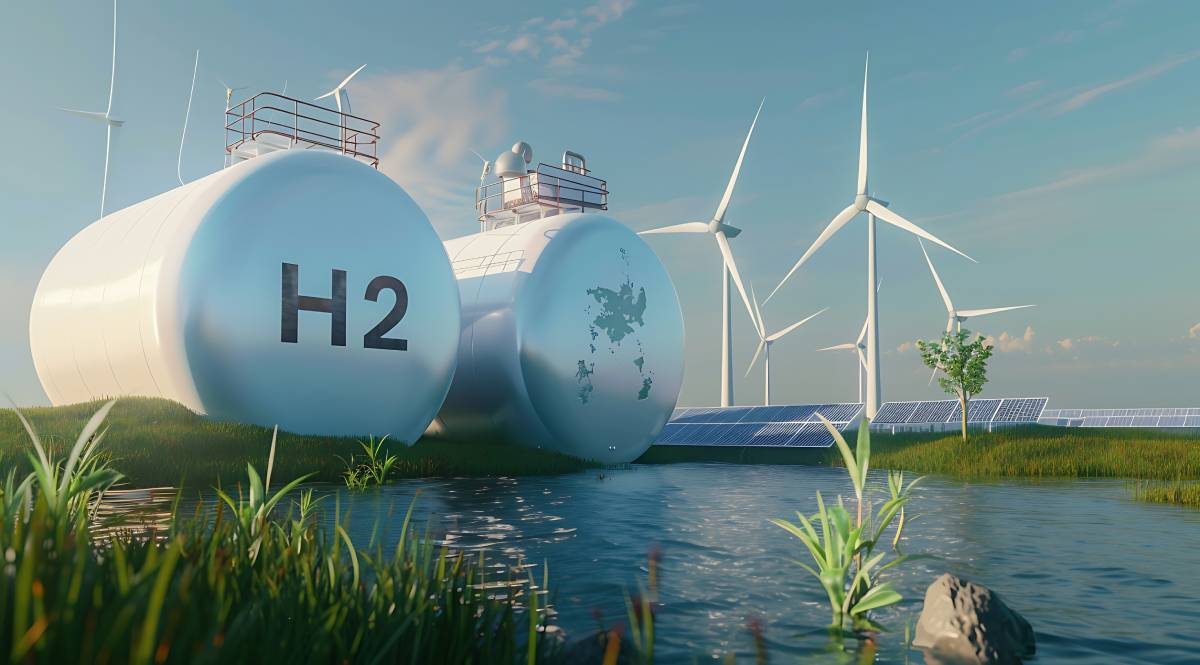
 Illustrative image – not actual.
The Indian Oil Corporation (IOC) will build the nation's first green hydrogen plant at its Mathura refinery, Uttar Pradesh as it aims to prepare for a future catering to the growing demand for both oil and cleaner forms of energy.
IOC has drawn a strategic growth path that aims to maintain focus on its core refining and fuel marketing businesses while making bigger inroads into petrochemicals, hydrogen and electric mobility over the next 10 years.
The company will not set up captive power plants at all its future refinery and petrochemical expansion projects, instead use 250 MW electricity it produces from renewable sources like solar power.
The company has a wind power project in the state of Rajasthan. The company intends to wheel that power to its Mathura refinery and use that electricity to produce absolutely green hydrogen through electrolysis.
This will be the nation's first green hydrogen unit. Earlier, the projects have been announced to produce grey hydrogen using fossil fuels such as natural gas.
Hydrogen, in itself, is a clean fuel but manufacturing it is energy-intensive and has carbon byproducts. Brown hydrogen is created through coal gasification while the process of producing grey hydrogen throws off carbon waste, while blue hydrogen uses carbon capture and storage for the greenhouse gases produced in the creation of grey hydrogen.
Green hydrogen production, the clean hydrogen resource, uses renewable energy to create hydrogen fuel.
The company has selected Mathura by virtue of its proximity to Taj Trapezium Zone (TTZ). The green hydrogen will replace carbon-emitting fuels that are used in the refinery to process crude oil into value-added products such as petrol and diesel.
The company has got a number of expansions down the line which are already approved. IOC's refinery expansion plans include raising the capacity of units at Panipat in Haryana and Barauni in Bihar and setting up a new unit near Chennai.
The company is going to add 25 million tonne of refining capacity by the year 2023-24. The company is 80.5 million tonne now including CPCL, and going to be 105 million tonne.
IOC was pushing ahead with research on carbon capture, utilisation and storage technologies space where it is seeking global collaboration to meet its Paris climate goals.
The company is planning to set up several hydrogen production units on a pilot basis. This includes a project at Gujarat refinery to produce finite purity hydrogen of 99.9999 percent for hydrogen fuel cell buses.
About 15 fuel-cell-powered buses, with the fuel cells entirely India-made, are expected to ply in H2/2021. Since running these buses would require hydrogen, IOC is setting up a plant, whose capacity could be anywhere between 200 tpd and 400 tpd.
Petroleum refining and marketing will continue to be IOC's core businesses with much higher petrochemicals integration. Moreover, gas will play a larger role and the firm will have a presence in electric mobility space through charging stations at petrol pumps and a planned battery manufacturing unit.
The company had already commissioned battery swapping stations across many cities. The company has already installed 286 charging stations, including swapping stations, across the country, which will be raised to 3,000 EV charging stations in the next few years.