
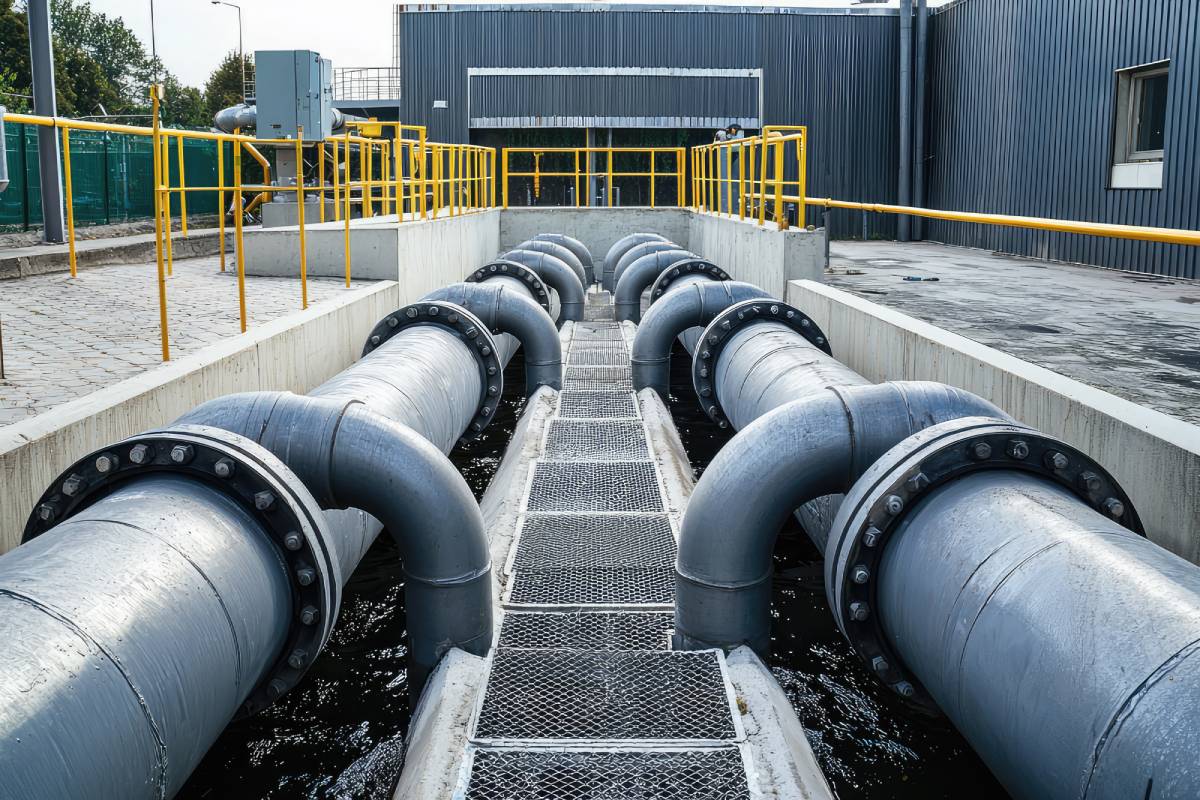
 Illustrative image – not actual.
Union Minister for Water Resources, River Development and Ganga Rejuvenation, Road Transport & Highways and Shipping Nitin Gadkari laid the foundation stones of six Namami Gange projects in Agra and Mathura, Uttar Pradesh on 23 January 2019.
The four projects in Mathura have a sanctioned cost of Rs 511.74 crore. These include two sewerage projects -- an integrated sewerage infrastructure for the city on hybrid annuity mode (HAM) with ‘One-City-One-Operator’ approach.
The other project is reuse of treated sewage water in Mathura refinery at a sanctioned cost of Rs 460.45 crore, and the other for rehabilitation of sewerage infrastructure and augmentation/upgradation of sewage treatment plant (STP) at Vrindavan at a sanctioned cost of Rs 33.82 crore. There is also a project for cleaning of 27 ghats at a sanctioned cost of Rs 3.60 crore.
For abatement of industrial pollution, there will be a project for upgradation of infrastructure of the existing CETP for textile printing units at the Mathura Industrial Area at a sanctioned cost of Rs 13.87 crore. The current sewage generation in Mathura is 47 MLD which is expected to increase to 61 MLD in 2035. Mathura sewage scheme under HAM-based public-private partnership (PPP) mode is the first-of-its-kind waste water treatment in the country.
The projects in Agra include comprehensive Sewerage Scheme for the city with ‘One-City-One-Operator’ approach on HAM basis for creating new STPs of 176 MLD, upgradation, rehabilitation of old plants and O&M for 15 years at a sanctioned cost of Rs 857.26 crore and construction of sewerage network in Western Zone, for laying of 251 km sewer lines, 47,827 house connections, rising main of 3.80 km under AMRUT Scheme at a sanctioned cost of Rs 353.57 crore.
The corresponding sewage generation in Agra is estimated at 268 MLD in 2020 and 341 MLD in 2035. A comprehensive sewerage project has been sanctioned under Namami Gange at a cost of Rs 857. 26 crore in Agra. The project is adding, in one go, additional treatment capacity of about 176 MLD to the existing 221 MLD developed over several years under different schemes.