
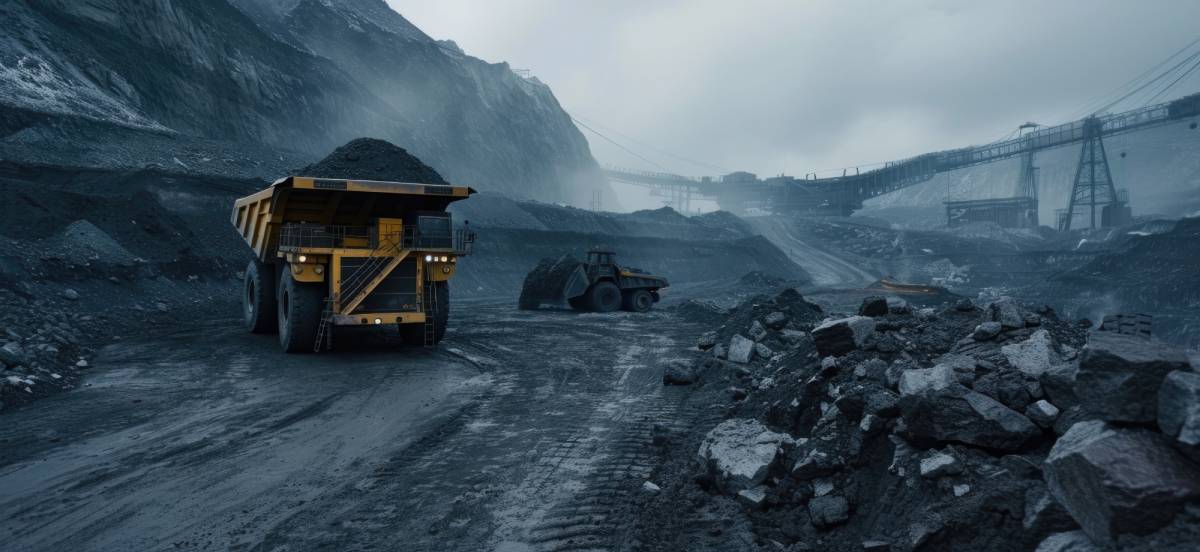
 Illustrative image – not actual.
The Union Government is trying to initiate few changes in the policy norms with special focus on coal. In order to encourage more and more coal mining projects in the country, New Mines and Mineral (Development and Regulation) Bill was cleared by a Group of Ministers. The bill envisages not only profit sharing regime for project affected people but also has a provision for setting up a clutch of ultra mega mining plants (UMMPs) in the country. As per the proposal, state governments will identify locations for large mines with respect to specific minerals such as iron ore, bauxite, chrome ore, copper, diamond and manganese. They will set up SPVs that will acquire land and obtain necessary clearances for the mine, whose size will be above a specified threshold. The whole facility will then be put up for bidding. The successful bidder will be the one willing to make the maximum upfront payment and promise royalty higher than others.
Under the profit sharing norm of the bill, coal companies will have to share 26 per cent profit with the local population. In case of other minerals such as iron ore, bauxite and limestone, the miners will have to share with the locals, an amount equal to the royalty paid in the previous year. The royalty norm has been approved for all minerals, except coal.
Further, the Union Ministry of Mines has mooted a proposal that favours opening up all mineral-bearing areas, barring sensitive zones, to entrepreneurs, thus accelerating the investment in the sector.
"India needs to encourage exploration and mining of highvalue, low-volume commodities like platinum, zinc, etc, through the initiative of private entrepreneurs," said S K Srivastava, Additional Secretary, Head of the ministry panel. The move aims to encourage exploration and mining of high-value, low-volume commodities like platinum, zinc, etc, through the initiative of private entrepreneurs. Foreign majors like De Beers India, Rio Tinto, Anglo American, Adi Gold Mining etc, are actively engaged in mineral exploration in the country.
In a related development, the Planning Commission has / is mulling over a proposal envisaging alternate coal blocks for the companies which lose captive coal blocks owing to environmental issues. Currently, the proposal is under consideration of the government. As per the proposal, companies that lose captive coal blocks owing to environmental issues, and are therefore, forced to defer construction of projects, will be given alternative blocks on a priority basis. If these companies have already made capital investments in the projects and the MoEF declares their captive coal blocks out of bounds, they will get new coal blocks without having to go through the bidding process. The policy will also give preference to large projects such as UMPPs for awarding alternative coal blocks.
However, the proposed policy on alternate coal block may not give any benefits to projects that have failed to take off or where there is a delay on part of the developers. Such companies will not get priority in alternate coal block allotment and will have to participate in a competitive bidding process. However, such companies will be guaranteed allotment as a co-allotter with the successful bidder.
The MoEF has exempted companies implementing projects under the National Solar Mission from environment clearance requirement. Nevertheless, the developers will have to demonstrate that they are not using protected land and have applied for water permits. Now, solar power producers will not have to fear for delay in their projects due to eco clearances. The Orissa Government is in the process of drafting a new tourism policy with focus on eco-tourism. Currently, the state government is in the process of preparing the draft of a policy framework, which will promote ecotourism in the state. It has identified places like Tikerpada, Bhitarkanika, and Chilika Lake for this purpose. The draft policy likely to be ready by September 2011 will then be sent to the cabinet for approval. Through this policy, the state government will ensure less ecological threat to these places while tapping the revenue generation potential of these spots.
The NHAI is mulling over a proposal, which will make private companies developing expressways to acquire land on their own. However, the proposal is still in the discussion stage and will be applicable only in the case of pilot projects. Currently, the entire land acquisition for a national highway project is done by the NHAI. It awards a project only after acquiring 80 per cent of the land required for the project. Private concessionaires pay a part of the compensation for land acquisition after the award of the project. It is working on new bidding norms for expressways, under which bidders will be selected based on lower toll rates and facilities like shopping complexes and hospitals, which will be developed alongside the expressways.
|
